CASA I (RO)
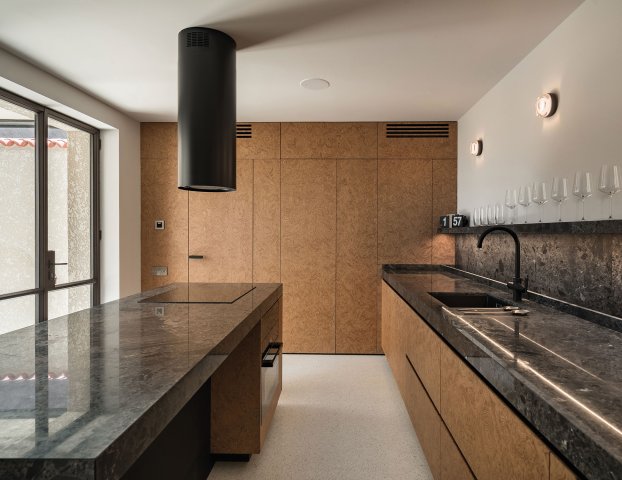
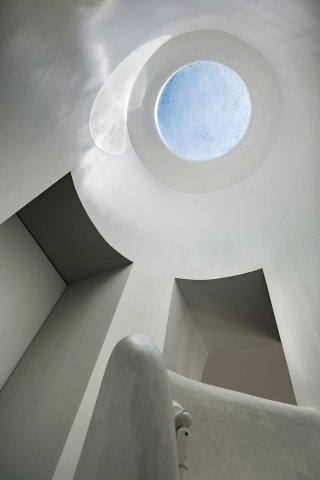
Light was a main subject of the design and a special requirement of the beneficiary. The relationship with natural light and its capture inside so that even the rooms with mono-orientation or indirect light can be illuminated throughout the day and year. The evening lighting seeks to provide an ambiance rather than showing the light source directly, the light is dimmable and configured in various scenarios.
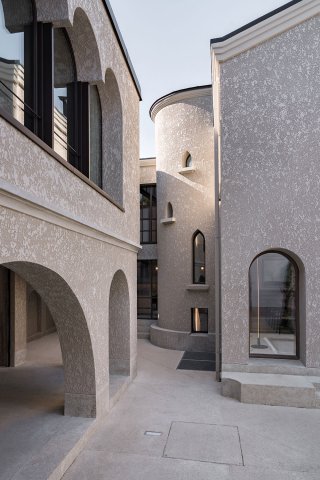
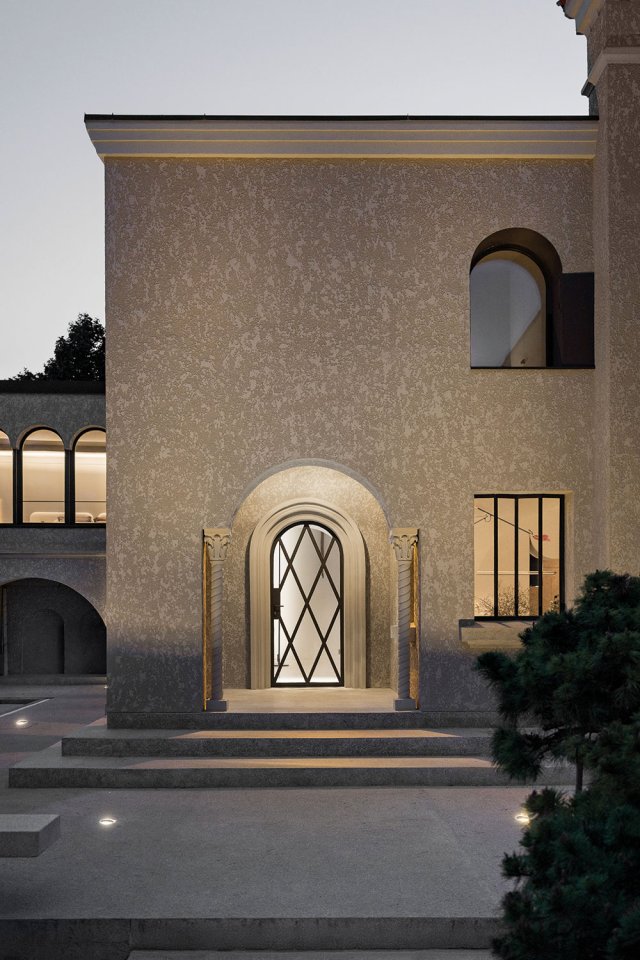
This project is a rehabilitation and an almost complete reconfiguration of an existing Florentine-Moorish style house — a style often found in interwar Bucharest houses and apartment buildings known for their architectural expression. Its most frequent elements include calcio vecchio plaster, twisted spindle columns with floral capitals accompanying arches or windows, arched, broken, or flattened openings, consoles with buttresses, and prominent window sills.
The challenge of the project was to reintegrate the original architecture with its specific details and materials into a building that is completely reconfigured on the inside and partially on the outside — a modern structure in which technology and functionality support spatiality. The process was long, beginning in 2020, and involved three building permits: two for the main body and one for the gazebo extension and walkway construction. The main volume was extended vertically, the arched windows lost their parapets, and the street-facing window was reconfigured to receive more morning light from the east.
The spatial reconfiguration was necessary to enable a functional reorganization and to bring scale and light into the interior. Through this, the architects created two major vertical spaces — the orangery and the dining room — which became the most representative living areas of the house, complemented by the living room and the exterior pavilion.
This project is a rehabilitation and an almost complete reconfiguration of an existing Florentine-Moorish style house — a style often found in interwar Bucharest houses and apartment buildings known for their architectural expression. Its most frequent elements include calcio vecchio plaster, twisted spindle columns with floral capitals accompanying arches or windows, arched, broken, or flattened openings, consoles with buttresses, and prominent window sills.
The challenge of the project was to reintegrate the original architecture with its specific details and materials into a building that is completely reconfigured on the inside and partially on the outside — a modern structure in which technology and functionality support spatiality. The process was long, beginning in 2020, and involved three building permits: two for the main body and one for the gazebo extension and walkway construction. The main volume was extended vertically, the arched windows lost their parapets, and the street-facing window was reconfigured to receive more morning light from the east.
The spatial reconfiguration was necessary to enable a functional reorganization and to bring scale and light into the interior. Through this, the architects created two major vertical spaces — the orangery and the dining room — which became the most representative living areas of the house, complemented by the living room and the exterior pavilion.
- Country
- Rumänien
- Architekt
- Eliza Yokina, Andrei Butusina, CUMULUS Architecture
- Innenarchitektur
- Eliza Yokina, Andrei Butusina, CUMULUS Architecture
- Fotograf
- Catalin Georgescu
- Anwendung
- Residential