
Finish options

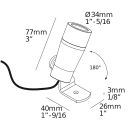
KIX
KIX S
Flexible, subtile, élégant et puissant : ce sont les mots-clés qui décrivent parfaitement Kix. Malgré son apparence discrète, Kix excel dans le rendement et la qualité de la lumière, idéale pour l'éclairage des allées ou d'autres applications paysagères. Kix est facile et flexible à utiliser grâce à sa tête réglable, conçue pour fournir un refroidissement optimal et éliminer les éblouissements.
Kix est disponible pour une installation murale ou au sol, sanglé autour d'un arbre ou monté dans des zones vertes douces avec son piquet. En plus de la version la plus robuste de Kix, il existe également une version S(mall) et M(edium). Kix S combine une powerLED avec une lentille, ce qui donne un joli faisceau lumineux de 10°. Tous les modèles sont IP65. Kix et Kix M(edium) peuvent être équipés d'accessoires : nid d'abeille et visière pour contrôler l'éblouissement.
MATÉRIAUX ET FINITIONS
Pour éviter le problème de l'oxydation et de la corrosion des produits d'extérieur, Delta Light utilise une sélection d'alliages d'aluminium à faible teneur en cuivre. La protection par traitement d'anodisation, sur tous les composants appropriés y compris ceux en aluminium moulé sous pression, améliore la résistance à la corrosion. La couche de conversion à base de titane offre une couche de protection supplémentaire avant la peinture polyester finale.
Nous appliquons d'importants traitements de surface avant la mise en peinture pour une protection maximale contre la corrosion, tels que le lavage à l'acide pour nettoyer la surface, le rinçage à l'eau déminéralisée pour éliminer les résidus, et l'application d'un traitement de conversion chimique pour protéger contre la rouille.
Notre revêtement de couleur en poudre de polyester est basé sur des résines de polyester saturées, appliquées électrostatiquement et durcies au four à 200°, garantissant une haute résistance au vieillissement atmosphérique et à l'exposition à la lumière UV. La peinture de surface extra résistante est garantie par un test de corrosion filiforme avec une exposition de plus de 1500h.
Toutes les procédures de revêtement sont suivies de tests quotidiens minutieux. Des contrôles stricts sont constamment maintenus sur les paramètres de chaque étape du processus, tels que la pureté, le pH, les concentrations chimiques, la température, etc. Cela permet d'obtenir la meilleure pénétration possible dans le substrat et la meilleure uniformité de la couche de conversion, garantissant ainsi une résistance à la corrosion et une adhérence de la peinture en poudre optimales.
Kix est disponible pour une installation murale ou au sol, sanglé autour d'un arbre ou monté dans des zones vertes douces avec son piquet. En plus de la version la plus robuste de Kix, il existe également une version S(mall) et M(edium). Kix S combine une powerLED avec une lentille, ce qui donne un joli faisceau lumineux de 10°. Tous les modèles sont IP65. Kix et Kix M(edium) peuvent être équipés d'accessoires : nid d'abeille et visière pour contrôler l'éblouissement.
MATÉRIAUX ET FINITIONS
Pour éviter le problème de l'oxydation et de la corrosion des produits d'extérieur, Delta Light utilise une sélection d'alliages d'aluminium à faible teneur en cuivre. La protection par traitement d'anodisation, sur tous les composants appropriés y compris ceux en aluminium moulé sous pression, améliore la résistance à la corrosion. La couche de conversion à base de titane offre une couche de protection supplémentaire avant la peinture polyester finale.
Nous appliquons d'importants traitements de surface avant la mise en peinture pour une protection maximale contre la corrosion, tels que le lavage à l'acide pour nettoyer la surface, le rinçage à l'eau déminéralisée pour éliminer les résidus, et l'application d'un traitement de conversion chimique pour protéger contre la rouille.
Notre revêtement de couleur en poudre de polyester est basé sur des résines de polyester saturées, appliquées électrostatiquement et durcies au four à 200°, garantissant une haute résistance au vieillissement atmosphérique et à l'exposition à la lumière UV. La peinture de surface extra résistante est garantie par un test de corrosion filiforme avec une exposition de plus de 1500h.
Toutes les procédures de revêtement sont suivies de tests quotidiens minutieux. Des contrôles stricts sont constamment maintenus sur les paramètres de chaque étape du processus, tels que la pureté, le pH, les concentrations chimiques, la température, etc. Cela permet d'obtenir la meilleure pénétration possible dans le substrat et la meilleure uniformité de la couche de conversion, garantissant ainsi une résistance à la corrosion et une adhérence de la peinture en poudre optimales.
- Luminaire luminaire
- 157 lm - 171 lm
- CRI
- 90
- CCT
- Blanc Halogène (+2700K) Blanc Chaud (+3000K)
- Pouvoir luminaire
- 2 W
- Distribution de lumière
- Symétrique
- Réglage
- 180° inclinable, 360° rotatif
- JA8 Certifie
- no
- Conforme à l'ADA
- no